Alloa Tower
Clackmannanshire, Scotland, is one of the largest tower houses in Scotland and dates from the 14th century. The Erskine family has owned it since around 1360 and the property is… Read More »Alloa Tower
Clackmannanshire, Scotland, is one of the largest tower houses in Scotland and dates from the 14th century. The Erskine family has owned it since around 1360 and the property is… Read More »Alloa Tower
Audley End. Essex, a Jacobean mansion with magnificent state rooms; ‘Capability’ Brown park.

“Number One, London”, The Wellington Museum, at London’s Hyde Park Corner, designed by Robert Adam and built 1771-78, sold in 1817 to the first Duke of Wellington; a wonderful collection… Read More »Apsley House photo
Appleby-in-Westmorland, Cumbria, started as a Roman castle and the building on that site started again in the 12th century, the Keep was built in 1170 in the ownership of King Henry I. The Castle site was granted to Robert de Vipont in 1203, and the Castle passed to the Clifford family in 16th century for 400 years. Lady Anne Clifford, one of the greatest names in the history of Westmoreland, undertook in the 17th century extensive rebuilding photo of the Castle.


 In 1153 Maurice Berkeley completed this fortress by the Severn Estuary at the command of Henry II, and ever since it has been the home of the Berkeley family – one of England’s oldest families who have given their name to numerous locations all over the world, from Berkeley Square in London to Berkeley Hundred in Virginia and Berkeley University in California. This ancient castle has been preserved and gradually transformed from a savage Norman fortress into a truly stately home with a wealth of treasures,
  paintings by English and Dutch masters, tapestries, furniture of an interesting diversity, silver and porcelain. Highlights of the castle are the massive Norman Keep with the Dungeon and the cell where King Edward II was murdered in 1327, the Picture Gallery, the Dining Room, the medieval Buttery and Kitchens, the Historic Great Hall and the magnificent State Apartments.
Read More »Berkeley Castle, Gloucestershire at About Britain
 Brough Castle is built on the site of a Roman Fort (Verterae, the outlines of which are still just visible), to the south of the town of Brough, and approached through the village of Church Brough, the Castle is undergoing some consolidation work under the care of English Heritage.
Built around 1090 by King William II the Castle has a chequered and bloody history. In 1136 it was seized by the Scots as was Appleby Castle nearby. Both were held by the Scots until 1157 when they were retaken by the English and given by the Crown to Hugh de Morville, though repossessed in 1173. The Scots almost destroyed the Castle in 1174 but between 1179 and 1190 Theobold de Valoines carried out much needed restoration work to improve its withered defences.Thereafter, the Castle stayed in Crown control until 1203 when King John gave it to Robert de Vipont.

 William De Braose constructed the motte and bailey castle at Bramber c1070, along with the Norman church, and most of the surviving masonry dates from this time. Except for a period of confiscation during the reign of King John, Bramber Castle remained in the ownership of the De Braose family until the line died out in 1324. During Norman times the coastline would have been much further inland, and at high tide the water would have reached the castle walls.
Despite very little surviving, the basic layout of some areas of the castle can be identified. The most prominent feature is a large, rugged lump of stone, all that remains of the Gatehouse tower. Still standing to almost its full height, a single window, and some floor joist holes, are clearly visible within the structure. Beyond the Gatehouse are the existing foundations of what is believed to have been living quarters and a guardhouse. The dressed pillars of an entrance can be made out, but the bulk of the remaining walls now consist of only the basic rough stone infil, the better quality dressing stone having long since been quarried away for use elsewhere. Lying to the north of the gatehouse is the original castle motte, it’s earthen mound rising to a height of some 30ft (10m). A short distance away is a section of the curtain wall and, again, this survives to a reasonable height, up to 10ft (3m) in places.

 Raised by the Peverel family in the 12thcentury, very little is known of the original castle at Bolsover. A stone Keep was built c1173, surrounded by a curtain wall with an outer bailey, but the wall was breached in 1216 during the reign of King John. Surviving fragments of this curtain wall were later incorporated in a wall walk that can be seen in the castle garden.
The castle became Crown property in 1155 when the third William Peverel fled into exile, but by 1400 it had lost its strategic importance. Years of occupation by tenants had left Bolsover Castle ruinous by the time it was purchased by Sir George Talbot in 1553. Talbot, later becoming the 6th Earl of Shrewsbury, is noted for two famous associations. Firstly, his marriage to ‘Bess of Hardwick’, probably the most astute business woman of the 16th century, who owned the vast Chatsworth estates. And then his lengthy term as keeper to the exiled Mary Queen of Scots, a 16 year duty that seriously drained the family’s resources.
Bishop’s Waltham, Southampton, Hampshire
 The last Bishop of Winchester to reside at Bishop’s Waltham left in a dung cart disguised as a farm labourer! He was escaping from Oliver Cromwell’s troops after unsuccessfully defending his palace, which was torn down and never rebuilt. Bishop’s Waltham was at the peak of its importance during the medieval period when it was the seat of the bishops of Winchester.
The palace once stood in an enormous park of some 10,000 acres. Most of the remains to be seen today date from the 12th and 14th centuries. There are substantial parts of the Great Hall and three-storey tower, and the moat which once surrounded the palace can be seen in places. A brick wall which once encircled the palace is still in place. Nearby is the abbot’s fish pond. Conservation is now complete on part of the north-east range of guest rooms, latterly a farmhouse. Inside is an exhibition on the history of Bishop’s Waltham Palace. Bishops Waltham Palace

 Continuously occupied by the Berkeley family since the 12th century, Berkeley Castle consists of a Norman, sandstone Keep with three semi-cylindrical turrets, and an Inner Ward surrounded by low-lying, 14ft thick walls. At one time there was a moat and the traditional Outer Ward to provide a defence strategy to the Inner Ward. The huge, round Keep is over sixty feet high, and is one of the oldest parts of the surviving castle.
Robert Fitzharding was in occupation during the mid-12th century when he was given permission by Henry II to construct a castle made of stone, to replace the former timber construction. It was from the descendants of Robert Fitzharding, who liked to describe themselves as ‘of Berkeley’, that lead to the family name still used today.

 During medieval times the manor of Belton was owned by St Mary’s Abbey at York but, after the Dissolution of the Monasteries, the land reverted back to the Crown. No architectural evidence has been found of the original manor house, if indeed there was one, but the surviving gate piers of a post-Dissolution residence can still be seen in the north wall by the Orangery. In the late 17th century, having inherited most of his great-uncle’s wealth as well as his estate at Belton, Sir John Brownlow decided to build a new country house for his family. Several architects have been associated with Belton House, including Sir Christopher Wren, but it is more feasible that William Winde and William Stanton were largely responsible for the design and construction of the property, possibly seeking advice from Roger Pratt.
Audley End is largely an early 17th century country mansion, which was once a palace in all but name. Formerly the site of a Benedictine monastery (Walden Abbey), granted to… Read More »Audley End Mansion
APSLEY HOUSE NO.1 LONDON THE LONDON PALACE OF THE 1ST DUKE OF WELLINGTON Apsley House, home of the first Duke of Wellington, is one of the capital’s finest residences. Famously… Read More »Apsley House – The Wellington Museum
 In the marvellous sweep of Cardigan Bay stand the ruins of one of Edward I’s late 13th century castles. Of the seven major English strongholds he established in Wales, Aberystwyth has fared least favourably in the survival stakes. Now little more than a few fragmented chunks of masonry displayed in a well-kept public park, the castle has lost its imposing hold on the town.
At one time guarded by one of the largest Iron Age forts in West Wales, Aberystwyth has been a place of strategic importance throughout history. The first Norman castle, built on a site further south, was begun by Gilbert de Clare but this has long since disappeared, having been destroyed and rebuilt numerous times during 200 years of political and family feuding. When Edward I begun his castle in 1277, it was a magnificent lozenge-plan concentric building of two stone curtain enclosures, flanked by sturdy round towers. Each curtain had a twin-towered gatehouse, the smaller outer gate leading to a barbican, and the inner gatehouse a substantial fortress with domestic accommodation. Excavations have revealed that a great hall stretched from this gatehouse to the south tower of the inner curtain, some 60ft long (18.3m) and 42ft wide (12.8m).
Bánffy Castle is a baroque building of the 18th century in Cluj-Napoca, designed by the German architect Johann Eberhard Blaumann. Built between 1774 and 1775 it is considered the most… Read More »The Banffy Palace Cluj-Napoca

The Royal castle of Săvârşin, near Arad, Transylvania, close to the Hungarian border, is the country seat of the deposed king Michael I of Romania.
Iassy (Iasi) is the old capital of Moldavia Kingdom, now part of Romania. The Palace of Culture, acknowledged as effigy of the city of Iasi, was built in the neogothic style and as such was one of the last expressions of Romanticism in the official architecture.
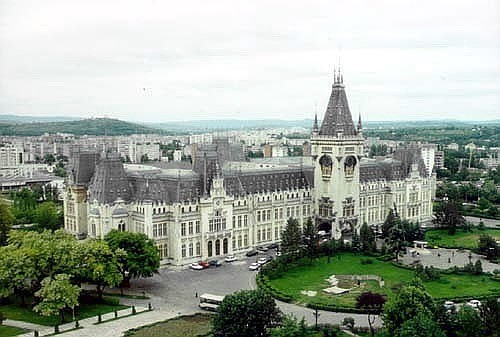
Although it was not raised on top of ancient foundations, as people thought at the beginning of the 20th century, the Palace was partly built on top of the ruins of the mediaeval princely courts, mentioned in a document of 1434, and partly on top of the foundations of the former (neoclassical) palace, dated to the time of Prince Alexandru Moruzi (1806-1812), rebuilt by Prince Mihail Sturza (1841-1843) and finally demolished in 1904. It was from this latter building that the Palace inherited the legend of the 365 rooms, as many as the days within one year.
