Location: East-Europe, Romania, Dobrogea region. The Cave Churches of Basarabi (Murfatlar)
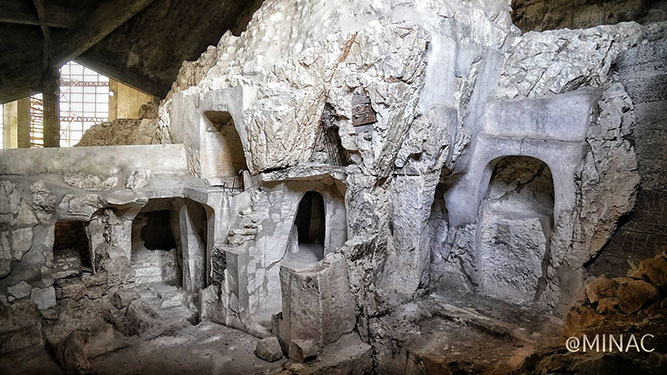
Description: Basarabi (or Murfatlar, Constanța county). In the southern edge of the commune, the spectacular vestiges of a quarry and monastic settlement with several small churches dug in the chalk, dating from the 10th-12th centuries. (see the list of the main archaeological sites in Romania )
The ensemble of rock monasteries was preserved and restored through a European project from 2012, entitled “The Mystery of the Chalk Hill – The Rock Churches of Basarabi (Murfatlar)”. The complex also benefited from AFCN funding – the heritage component.
According to The History and Archeology Museum from Constanța, the owner of the complex from Basarabi:
The monastic complex from Murfatlar-Basarabi is part of the “horizon of rock monastic settlements”, defined by a suite of complexes dug into the rock (or chalk), all located in the south of historical Dobrogea. The monastic refuges – the caves from Casian, Cheia – “la Izvor”, Limanu, the quarry from Aliman and possibly the one from Cernavodă, the ensembles from: Dumbrăveni, Kanaghiol – Silistra, Suha-Reka, from the area of Caliacrei and Varna have were used in the same period as the Murfatlar-Basarabi settlement.
The Murfatlar-Basarabi cave complex is arranged on three levels or terraces, corresponding to three stages of activity that followed each other in time quite quickly: the highest terrace represented by the entrance to the B 1 church and by the E 3 and E churches 5, funerary galleries G 1-5; the middle terrace is marked by the entrance to the B 3 church with the respective annexes and most of the graves, and the lower terrace by the entrance to the B 4 church.
see on wiki: https://en.wikipedia.org/wiki/Murfatlar_Cave_Complex
Discover more from Sic Tranzit
Subscribe to get the latest posts sent to your email.